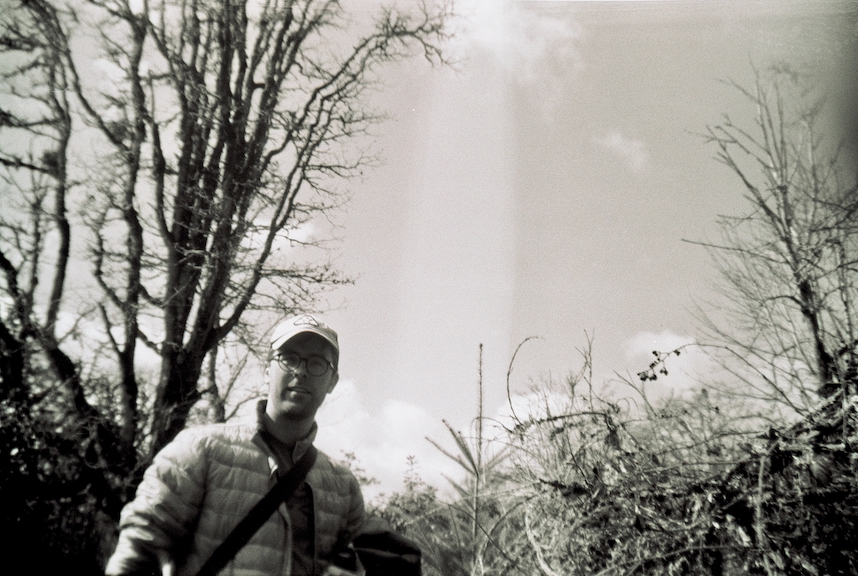
Hi there! My name is Daniel Watkins. I’m a climate scientist specializing in Arctic sea ice and atmosphere. I received my doctorate from Oregon State University in spring 2022, and currently work as a senior research associate in the Wilhelmus Lab at Brown University. I participated in the MOSAiC Arctic expedition (which I wrote about here), where I helped deploy instruments on ice in the central Arctic to measure the dynamics of a changing system. At the Wilhelmus Lab, I’m working to develop open-source software to track sea ice floes from satellite images, and to use these new observations to understand how sea ice behaves at the scale of individual sea ice floes.
My work revolves around the idea that the Arctic atmosphere, sea ice, and ocean form a complex coupled system. Changes to individual parts of a coupled system can impact the other parts in surprising ways. That’s why the dramatic loss of sea ice in the Arctic over the last 40 years isn’t only a problem for people and animals who live and work on ice, but rather can affect the whole Earth’s climate. Exactly how the effects of sea ice loss trickle out and impact the atmosphere and ocean is complicated, and there’s lots we still need to figure out.
In addition to my research work, I’m a science writer for Science Journal for Kids. There, I work with a team to translate cutting-edge science articles into a kid-friendly, teacher-ready format. Previously, I was a Science Communication Fellow at the Oregon Museum of Science and Industry, and a host on the science radio show and podcast Inspiration Dissemination.
In the news
- Brown Daily Herald article on our analysis on linking sea ice floe rotation and ocean enstropy (led by Dr. Minki Kim) https://www.browndailyherald.com/article/2026/04/movement-of-spinning-ice-plates-can-provide-insight-into-ocean-turbulence-brown-study-finds
- Press release on our analysis of the influence of bathymetry on sea ice motion in the Greenland Sea https://www.brown.edu/news/2023-08-16/sea-ice-motion
- Conversation with PolarPredictNews about buoy deployment https://www.polarprediction.net/fileadmin/user_upload/www.polarprediction.net/Home/News/PolarPredictNews/Newsletter_19_Stand0710v3_screen.pdf
- E&E article reporting from aboard the R/V Akademik Fedorov during the MOSAiC Expedition https://www.eenews.net/articles/frightening-scientists-contemplate-the-melting-arctic/
- Washington Post article on the preparation for the MOSAiC Expedition https://www.washingtonpost.com/graphics/2019/national/science/arctic-sea-ice-expedition-to-study-climate-change/
Vitae
Education
- 2022 // PhD Ocean, Earth, and Atmospheric Sciences, Oregon State University. Thesis title: Vertical structure of the lower tropopause in a changing Arctic. Advised by Dr. Jennifer Hutchings
- 2015 // MS Mathematics, Drexel University
- 2013 // BS Applied Mathematics, Brigham Young University-Idaho
Experience
- 2023-Present // Senior Research Associate, Center for Fluid Mechanics, Brown University
- 2022-2023 // Postdoctoral Research Associate, Center for Fluid Mechanics, Brown University
- 2019 // MOSAiC Arctic Expedition participant
- 2015-2022 // Graduate fellow / research assistant / teaching assistant, Oregon State University
- 2014 // Graduate student researcher, Risk Analysis and Decision Support, Los Alamos National Laboratory. Advised by Dr. Leticia Cuellar-Hengartner
- 2013 // National Security Internship Program participant, Applied Statistics and Computational Modeling, Pacific Northwest National Laboratory. Advised by Dr. Landon Sego
- 2012 // Visiting student researcher, Risk Analysis and Decision Support, Los Alamos National Laboratory. Advised by Dr. Leticia Cuellar-Hengartner
Publications
13. Watkins, Buckley, Kim, Hutchings, and Wilhelmus (2026) “Characterizing the Marginal Ice Zone in the Greenland Sea Through Seasonal Floe-Scale Sea Ice Observations,” Journal of Glaciology, 1-49. doi:10.1017/jog.2026.10165
12. Kim, Manucharyan, DiBenedetto, Buckley, Watkins, and Wilhelmus (2026) “From spinning sea ice floes to ocean enstrophy spectra in the marginal ice zone,” Geophysical Research Letters, 53, e2025GL119371. doi:10.1029/2025GL119371
11. Ahmed, Fox-Kemper, Watkins, Wexler, and Wilhelmus (2025) “Estuarine temperature variability: Integrating four decades of remote sensing observations and in-situ sea surface measurements,” Remote Sensing of Environment, 322, 11463. https://www.sciencedirect.com/science/article/pii/S0034425725000471?via%3Dihub
10. Watkins, Persson, Stanton, Solomon, Hutchings, Haapala, and Svensson (2024) “Air-ice-ocean coupling during a strong mid-winter cyclone: Observing coupled dynamic interactions across scales,” Journal of Geophysical Research: Atmospheres, 129, e2024JD041057. https://agupubs.onlinelibrary.wiley.com/doi/10.1029/2024JD041057?af=R
9. Rabe, Cox, …, Watkins, and others (2024) “MOSAiC Distributed Network: observing the coupled Arctic system with multidisciplinary, coordinated platforms,” Elementa: Science of the Anthropocene, 12 (1): 00103. doi:10.1525/elementa.2023.00103
8. Watkins, Bliss, Hutchings, and Wilhelmus (2023) “Evidence of abrupt transitions between sea ice dynamical regimes in the East Greenland marginal ice zone,” Geophysical Research Letters. Vol. 50, e2023GL103558. https://doi.org/10.1029/2023GL103558
7. Bliss, Hutchings, and Watkins (2023) “Sea ice drift tracks from autonomous buoys in the MOSAiC Distributed Network,” Nature Scientific Data, 10, 403 (2023). https://doi.org/10.1038/s41597-023-02311-y
6. von Albedyll, Hendricks, … , Watkins, and others (2022) “Thermodynamic and dynamic contributions to seasonal Arctic sea ice thickness distributions from airborne observations,” Elementa: Science of the Anthropocene. Vol. 10, Issue 1, Apr. 2022. https://doi.org/10.1525/elementa.2021.00074
5. Nicolaus, Perovich, Spreen, …, Watkins, and others (2022) “Overview of the MOSAiC expedition: Snow and sea ice,” Elementa: Science of the Anthropocene. Vol. 10, Issue 1, Feb. 2022. https://doi.org/10.1525/elementa.2021.000046
4. Krumpen, Birrien, Kauker, …, and Watkins (2020) “The MOSAiC ice floe: sediment-laden survivor from the Siberian shelf”, The Cryosphere, 14, 2173–2187, doi:10.5194/tc-14-2173-2020
3. Simpson and Watkins (2019) “Relative entropy minimization over Hilbert spaces via Robbins-Monro”. AIMS Mathematics, 2019, 4(3): 359-383. doi: 10.3934/math.2019.3.359
2. Watkins, Cuéllar, Kubicek, Rodriguez, and Stroud (2015) “Identifying Security Checkpoint Locations to Protect the Major US Urban Areas.” Homeland Security Affairs, Vol. 11, Issue 8, pp. 1-17, 2015. https://www.hsaj.org/articles/6311
1. Watkins, Sego, Holmes and others (2013) “Assessing Performance and Tradeoffs of Bioforensic Signature Systems,” Proceedings of the 2013 IEEE Homeland Security Technologies Conference. Nov. 13-14, 2013 https://ieeexplore.ieee.org/document/6699019
Selected Presentations
Watkins, Hutchings, and Wilhelmus (2026) “Extending sea ice observation networks with floe-scale remote sensing,” Oral presentation, Arctic System Science Conference, Potsdam, Germany, March 2026
Watkins, Buckley, Kim, Hutchings, and Wilhelmus (2026) “Linking sea ice dynamics and the floe size distribution in Arctic marginal ice zones through floe-scale observations,” Oral presentation, Ocean Sciences Meeting, Glasgow, Scotland, February 2026
Watkins, Hutchings, and Wilhelmus (2025) “Assessing interannual variability in the marginal ice zone,” AMS Polar Meteorology and Oceanography (AMS Denver Summit), Denver, CO, May 2025 https://essopenarchive.org/users/599762/articles/1298142-assessing-interannual-variability-in-marginal-ice-zones
Watkins, Buckley, Kim, and Wilhelmus (2024) “Observing floe-scale sea ice motion in the Greenland Sea marginal ice zone during summer,” AGU Fall Meeting, Washington, DC, December 2024 https://doi.org/10.22541/essoar.170431114.48516908/v1
Watkins, Buckley, Kim, and Wilhelmus (2023) “Ice Floe Tracker: An Open-Source Tool Enabling Novel Observations of Sea Ice Motion from Visual Remote Sensing Imagery”, AGU Fall Meeting, San Francisco, CA, December 2023 10.22541/essoar.170365234.41977792/v1
Watkins, Persson, Hutchings, Stanton, and Solomon (2023) “Sea Ice and Ocean Response to a Strong Mid-Winter Cyclone in the Arctic Ocean,” AGU Fall Meeting, San Francisco, CA, December 2023, 10.22541/essoar.170365235.53452562/v1
Writing
Science Journal for Kids
November 2025: How can growing seaweed help fight climate change?
August 2025: How do lizards find food to eat?
June 2025: What can you do with a microscopic robot?
March 2025: What can fossils tell us about growing up?
November 2024: How does thiamine-fortified salt taste?
August 2024: Can shipwrecks help protect ocean creatures?
June 2024: How does the brain adapt to blindness?
March 2024: How can we tell whether we are talking to a computer or a person?
November 2023: How well can a computer think?
August 2023: Why is it so hard to bring back extinct species?
August 2023: What kind of foods did Neanderthals eat?
August 2023: How can tardigrades survive without water?
April 2023: When did cats first start living with people?
January 2023: What was life like in medieval England?
November 2022: How does sunscreen make corals sick?
October 2022: Why can some monkeys live high in the mountains?
September 2022: How can we know about dinosaurs’ social lives?
March 2022: How did the warrah reach the Falkland Islands?
March 2022: How does air pollution affect people differently?
December 2021: How can virtual reality help construction engineers?
November 2021: What can ancient DNA tell us about Stone Age people?
October 2021: Do hot neighborhoods affect everyone equally?
October 2021: How did COVID lockdowns affect air pollution?
September 2021: Can peer pressure help teens make safer decisions?
August 2021: How can caring grown ups help children overcome adversities?
August 2021: How will climate change affect Arctic birds?
May 2021: How can we find out about ancient Egyptian germs?
April 2021: How do ravens’ thinking skills compare with apes’?
Other Science Writing
08/05/2020: Freeze Frame
03/14/2020: Libraries of possibilities
02/09/2020: Fitness for Life: Sport psychology and the motivations behind healthy lifestyles
02/02/2020: Swimming with Salmon(ids)
11/10/2019: You don’t look your age
6/09/2019: Perceptions of Trust
4/21/2019: Repair, don’t replace: developing a new treatment for lower back pain
3/17/2019: Magnet blocks, connect the dots, and the world of modern mathematics
2/17/2019: Feather collections and stressed-out owls
12/09/2018: Applying medical anthropology: a history of stress in Puerto Rico and its impacts on birth outcomes
08/24/2016: OSU Harnesses Personal Computers for Climate Research
08/31/2016: Oregon State Scientist Awarded Tasty $3 Million Grant

